
FREMO Event
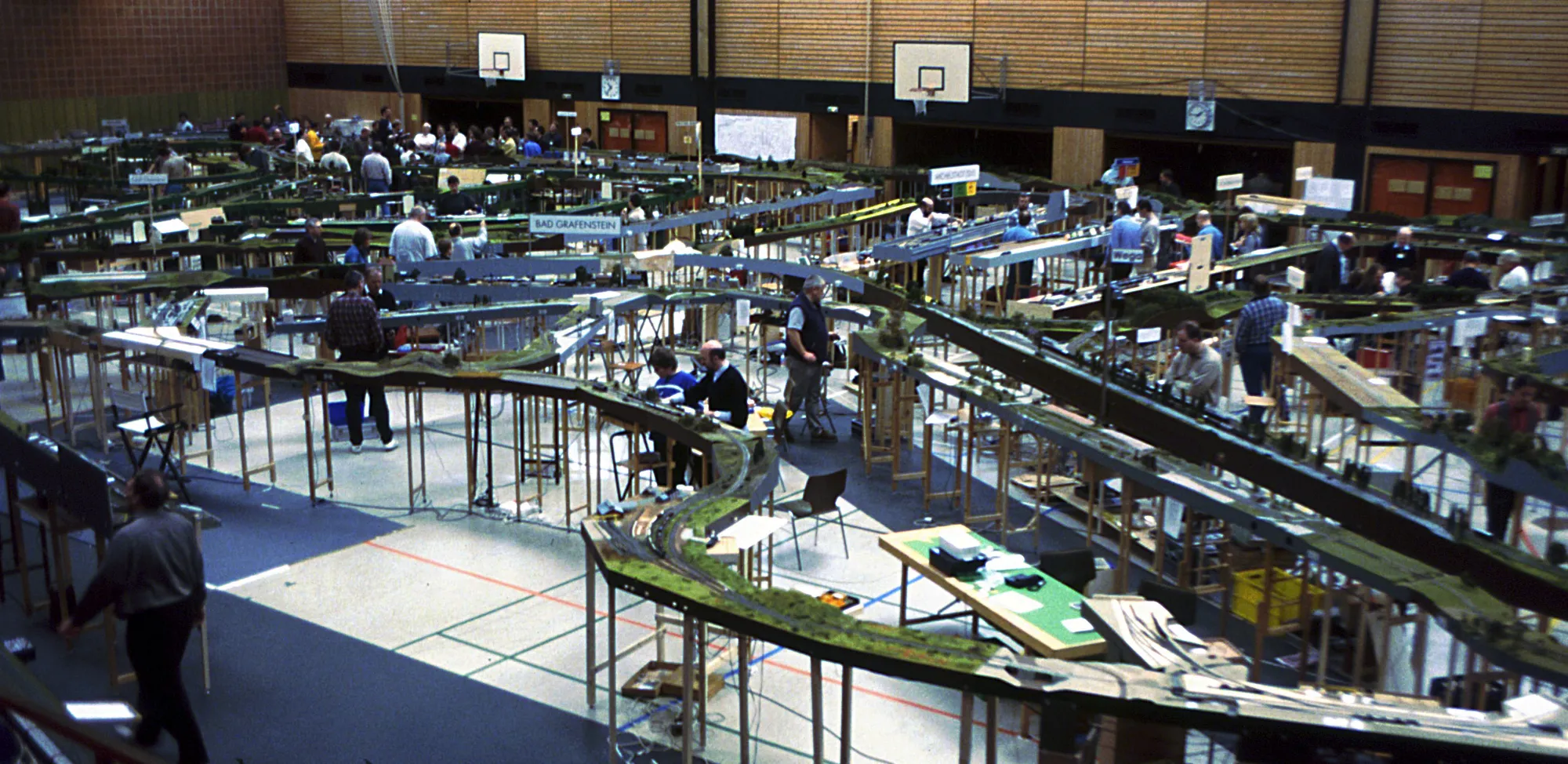
We hire a large hall and assemble a layout from model railway modules with matching end profiles. Trains then travel loooong distances – operated according to a timetable.
Short answer: No!
Long answer: I’m fascinated by the diversity of this hobby. Successful railway modelling is a blend of research into the real-life prototype, imagination, design, precision mechanics, engineering, woodwork, electrical and electronic engineering, digital technology, IoT, graphics, painting, modelling and sculpting. Last but not least, a touch of romance is part of it too.
Of course, you can also play with a model. And here, too, there is a huge variety. Solving shunting puzzles on a small scale at home on your own, or on a really large scale with lots of people at a FREMO meeting (see below):
FREMO Event
We hire a large hall and assemble a layout from model railway modules with matching end profiles. Trains then travel loooong distances – operated according to a timetable.
fiNe-scale (or FS160) is model railway construction in 1:160 scale (N gauge) that adheres to the highest standards of prototypical accuracy and visual realism. While the technical core of the standard is the wheel-rail interface, the philosophy extends to every aspect of the build—from track geometry and landscape design to the scratch-building of rolling stock and authentic operational practices.
Super Realistic
Take a look at the bird’s-eye view of the “Wohltorf” module below. This isn’t a drone photo of a real landscape; the module is simply sitting on the sunny floor, and I took the photo from one meter height.
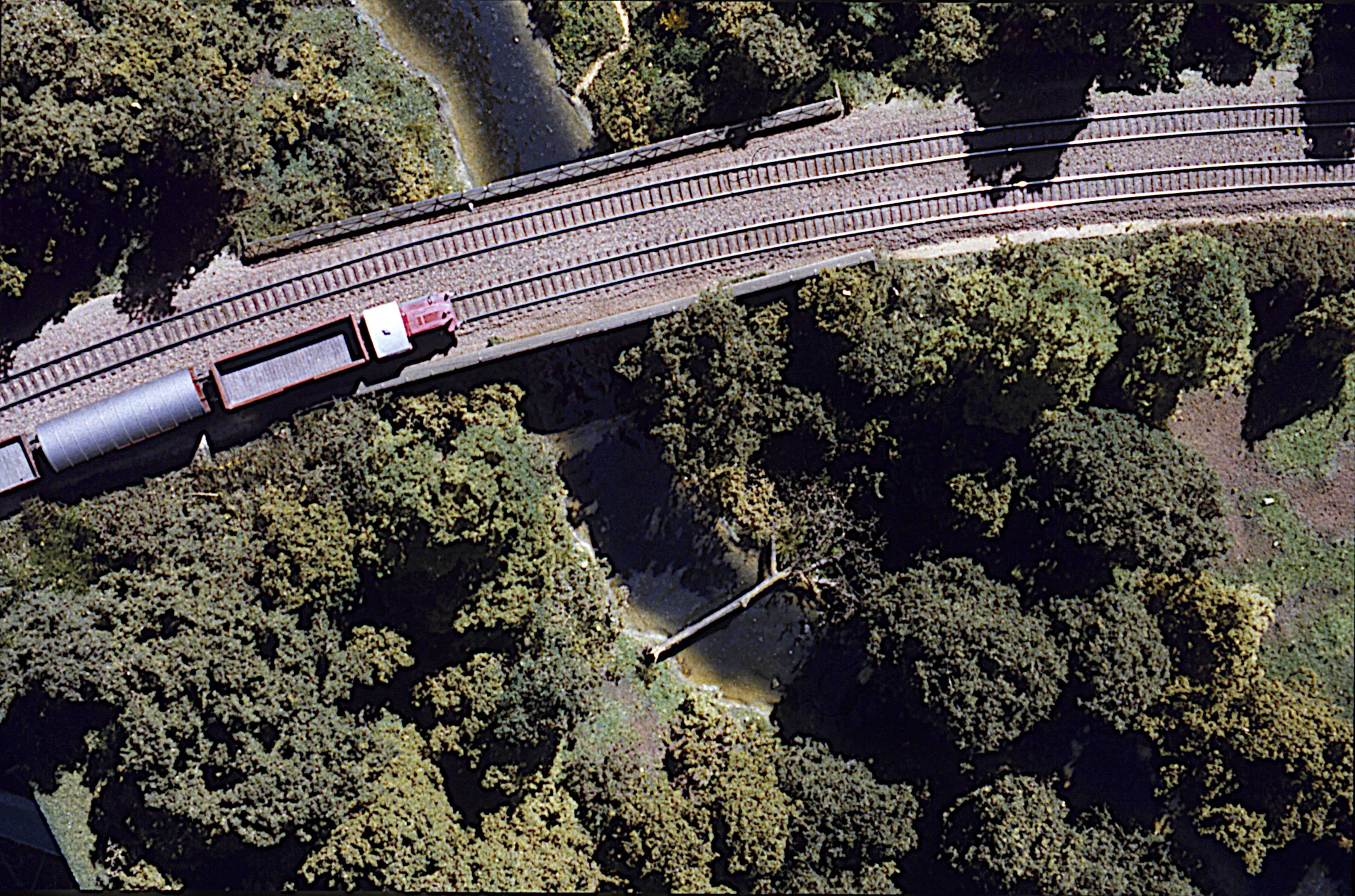
Standard N-gauge models are typically built to NEM standards (Normen Europäischer Modellbahnen). Established in the mid-1960s, these standards were designed for children’s toys, allowing for extremely tight track radii (approx. 20 cm). This requires significant compromises: wheels are disproportionately wide, while rail profiles and wheel flanges are excessively high.
In contrast, fiNe-scale track and turnouts are not available “off the shelf”—they are hand-laid by the modelers themselves. The proportions are true to the prototype: radii start at a generous 120 cm (190 m on the prototype), wheels are narrowed to 1.3 mm (down from the 2.0 mm NEM standard), and flange grooves are reduced to a precise 0.5 mm. We use a rail height of just 1 mm (Code 40), which looks far more realistic than the 2 mm “I-beams” found on standard track.
The members of the association »Freundeskreis Europäischer Modellbahner (FREMO)« regularly organise the module meetings mentioned above.
The core concept of FREMO is based on decentralisation: instead of a static home layout, members build portable segments that are combined at meetings to form huge, ever-changing layouts. To ensure these modules fit together perfectly, standards define the geometry of the end profiles, the precise track alignment and the landscape transitions. Technically, too, the system is fully compatible thanks to standardised electrical connections for traction current (DCC) and a continuous LocoNet for the hand controllers.
Within these standardised parameters, builders enjoy complete creative freedom in designing the shape, length and theme of their layouts. Before each meeting, a bespoke network is planned using CAD software based on the registered modules, which is then jacked up on site to a uniform height of usually 1300 mm. However, these meetings are not public exhibitions, but private events where the focus is on joint, prototypical operation according to a timetable. Anyone wishing to attend as a guest must therefore usually register in advance so as not to disrupt the organised proceedings.
Anyone who has read this far must be interested. 😉
If you’d like to get an idea of how to build a set of turnouts based on the railway’s original plans, you’ll find a manual below. In it, I have tried to summarize the knowledge and experience in the form of a guide that Jens Emmermann, who is one of the masterminds of fiNe-scale, shared with me and which I finalized together with him.
There are slightly other ways to build points and track. Be sure to check out Henk Oversloot’s FS160 pages as well.
I’ve personally gained a lot of valuable insight from both Jens and Henk; they are truly great mentors.
For more sources of information, impressions and guides have a look on my fiNe-scale Resources page.


