
Rubin Mill – Shunting Game with FREMO Module Adapter
The Idea
Section titled “The Idea”Inspired by John Whitby Allen’s Timesaver shunting puzzle, I developed a concept for a relatively small shunting game suitable for my living room. I have an ideal, compact space on the wall for two segment boxes, each measuring approximately 120 cm by 32 cm, which can be stored vertically one above the other. For operation, one box will be taken down and connected to the other to create the layout (see below).
As a member of FREMO, I would like to use this model as a module at FREMO event as well. To that end, I have designed an FREMO module adapter (see below). For this reason, the model also features a through track to which it is connected.
The model recreates an industrial trapped siding – German »Ausweichanschlussstelle (Awanst)« – within the Hamburger Hafenbahn network. But see for yourself…
The Subject
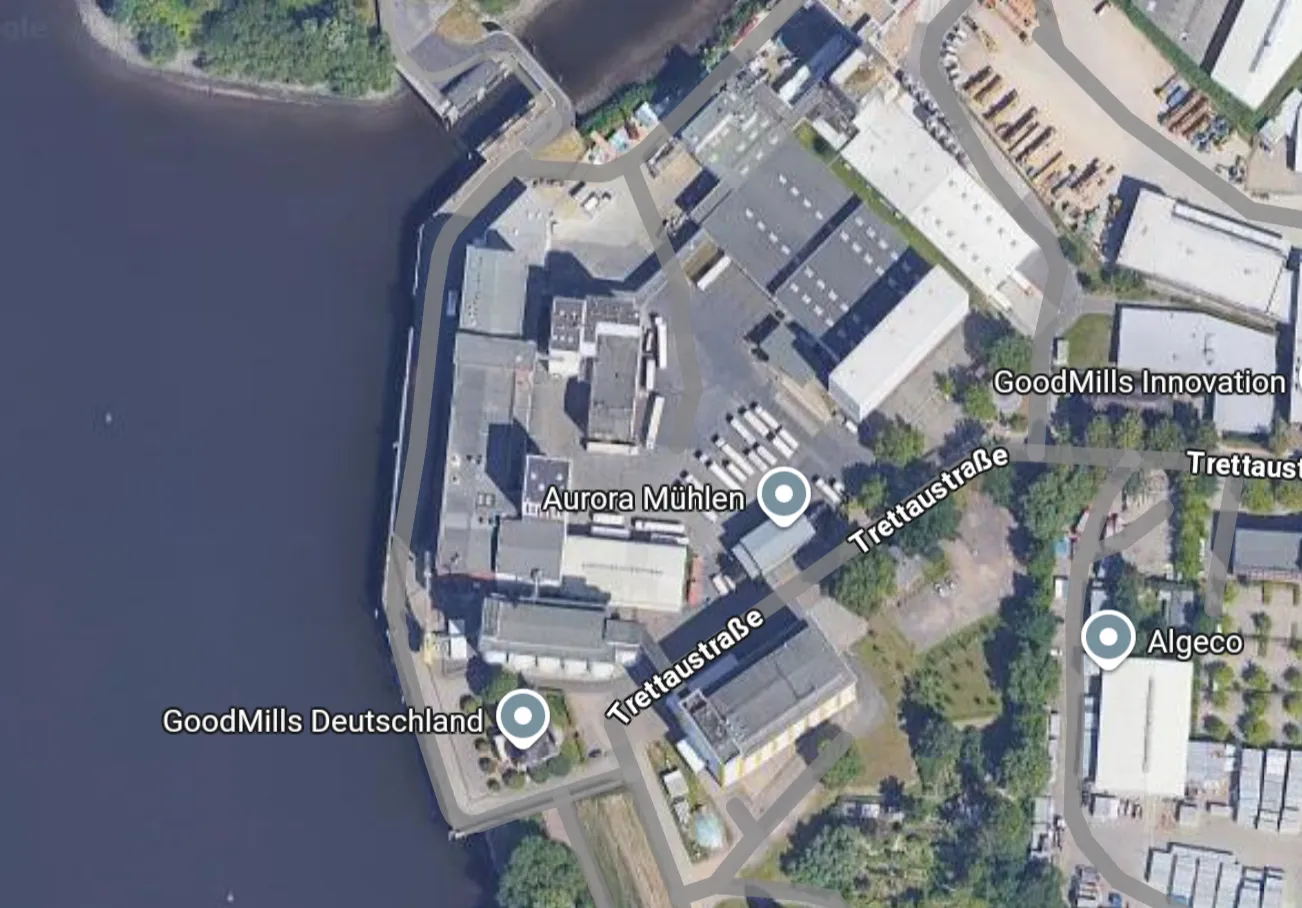
Section titled “The Subject”My shunting game, which I will call »Rubin Mill«, is inspired by the Aurora Mill (formerly Diamantmehl Mill). This mill is located on the Rethe, a connecting waterway in the Port of Hamburg, in Hamburg-Wilhelmsburg, and features quay facilities.
Several parts of the complex are listed buildings (historically preserved), which makes them attractive to replicate, including the main building (1953/1954), the boiler house (1896/1922), a residential building (1904), and two of five silos (silo II and silo III, 1934). See my photos below.
The mill has a well-developed quay facility, via which it is supplied with grain by inland waterway vessels. However, the mill also receives grain by lorry. A 2-metre-high concrete wall above the sheet piling protects the mill from flooding.
However, there is no longer a railway connection, and only minimal traces of it remain – approximately 20 metres of old grooved track in the yard entrance. The railway siding was never very extensive. In a track plan for the Wilhelmsburg Industrie Bahn dating from 1929, I can see a small track layout with three tracks. The model is therefore, just like its name, purely imaginary.
My design
Section titled “My design”The design calls for two trapezoidal segments, with the front side concave (in Hamburg Low German so called the »Waterkant«) and the back side convex for aesthetic reasons. The tallest structure will be the chimney at 40 cm, followed by the mill tower at 34 cm, the silos at 30 cm and the main building at 19 cm.
Track 1b has a special feature: it runs beneath the main building, which is therefore mounted on stilts at the rear (brilliant idea by Jens).
Click to zoom or download as PDF.
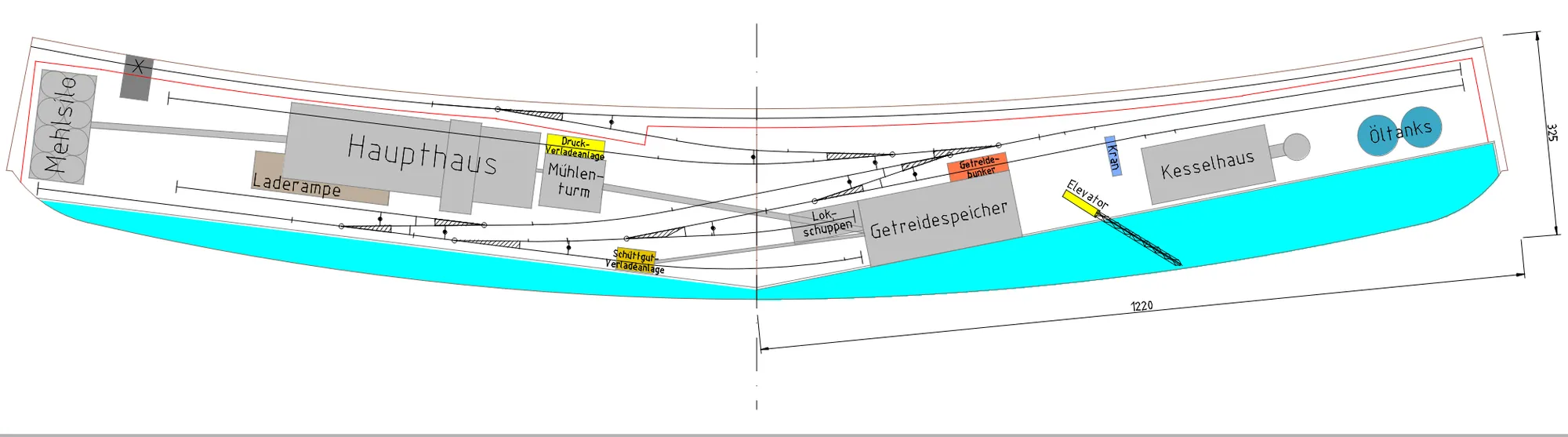
At the top: the main line of the Hamburg Port Railway running through; below that (in red), the boundary of the factory site; at the very bottom, the quay and (in blue) the water (Elbe/Rethe).
From left to right: Flour silo (Mehlsilo), Loading ramp (Laderampe), Main building (Haupthaus), Pneumatic loading system (Druck-Verladeanlage), Mill tower (Mühlenturm), Bulk loading system (Schüttgut-Verladeanlage), Engine shed (Lokschuppen), Grain elevator (Elevator), Grain silo (Getreidespeicher), Grain bunker (Getreidebunker), Crane (Kran), Boiler house (Kesselhaus), Heavy fuel oil tanks (Schweröl-Tanks).
Period
Section titled “Period”I am planning to build the module in a way that allows it to be used with a variety of rolling stock from Period III to VI. Today, the grain silos in the Port of Hamburg are served by rail using containers (potentially special bulk containers) on flat wagons. With this design, we can recreate that type of operation as well.
The Track Layout
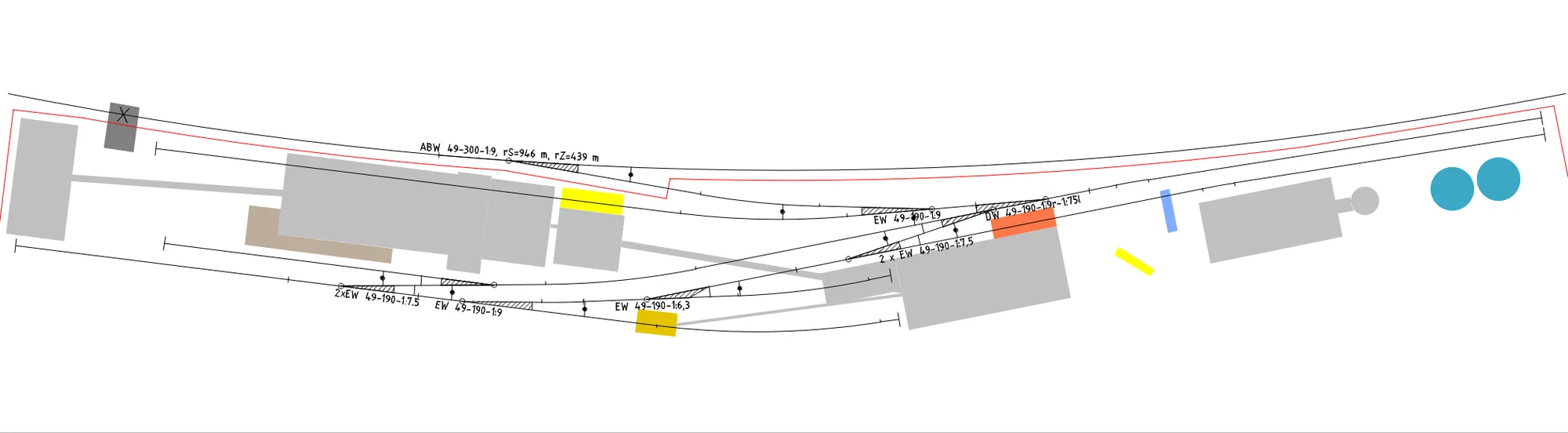
Section titled “The Track Layout”The track plan is my own free interpretation, inspired by the Timesaver. Construction features a minimum prototypical radius of 190 m (≙ ~119 cm) with Code 40 N scale track (FS160) and the points replicate the prototype turnout geometry. The industrial site is a trapped siding – German »Ausweichanschlussstelle (Awanst)« – to an imaginary single track through-line of the Hamburger Hafenbahn network.
Click to zoom or download as PDF.
Operations
Section titled “Operations”Keep in mind, the model is not optimized for operational throughput, as it is intended to be a shunting puzzle. However, unlike the original Timesaver, the track lengths are dimensioned in such a way that I believe meaningful operation is possible even at a FREMO meeting. To increase the difficulty level during shunting puzzles, the longer tracks can simply be occupied with wagons so that the available space becomes tight – exactly as the original Timesaver intends.
The track schema
Section titled “The track schema”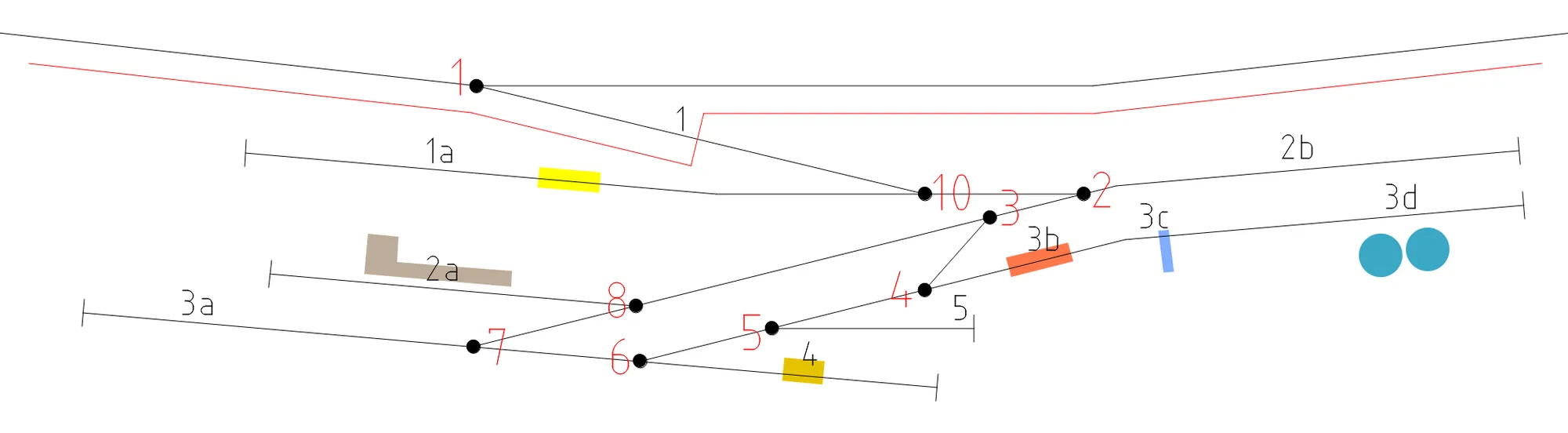
Tracks, purposes and lenths
Section titled “Tracks, purposes and lenths”| Track | Purpose | Length | Loading Point | Note |
|---|---|---|---|---|
| 1 | Entrance | Freight traffic only | ||
| 1a | Pressure Loading Facility | 930 mm | 92 mm | Flour loading, one wagon after another and as temporary siding for arriving and departing trains |
| 2a | Loading Ramp | 327 mm | 218 mm | |
| 2b | Siding | 678 mm | For arriving and departing trains | |
| 3a | Siding | 407 mm | ||
| 3b | Grain Bunker | 95 mm | Grain unloading, one wagon after another | |
| 3c | Loading Crane | 100 mm | ||
| 3d | Tank Farm | 530 mm (3b - 3d) | 135 mm | |
| 4 | Bulk Loading Facility | 480 mm | 100 mm | Grain loading, one wagon after another |
| 5 | Engine Shed |
The following operating procedures are planned:
Incoming train arrives from west
Section titled “Incoming train arrives from west”- passing turnout 1, 10 and 2 on track 2b
- • push back to track 1a (temporary only) or
• push back to track 3a (limited length) or
• push back to track 2a (limited length) - loco is leaving via turnout 10 and 1
Incoming train arrives from east
Section titled “Incoming train arrives from east”- pushing back via turnout 1, 10 and 2
- • leave dropped cars on 2b or
• forward via turnout 2 and 3 leaving dropped cars in front of turnout 8, running around via 7, 6, 5, 4, 3 and 2 or
• forward via on Track 3a (clear of turnout 7), pushing back dropping cars on track 3b/c/d - loco is leaving via turnout 10 and 1
Outgoing train to leaves eastwards
Section titled “Outgoing train to leaves eastwards”- • pick up outbound cars on track 1a, forward on track 2b or
• pick up outbound cars on track 2a, forward on track 2b or
• pick up outbound cars on track 3a, forward on track 2b - train is backwards leaving via turnout 10 and 1
Outgoing train to leaves westwards,
Section titled “Outgoing train to leaves westwards,”- • pick up outbound cars on track 2b or
• forward via turnout 2, 3 and 4 to pick up outbound cars on track 3d or
• forward via turnout 2, 3 and 4 to pick up outbound cars on track 3b/c/d 2 train is leaving via turnout 10 and 1
Goods dispatch
Section titled “Goods dispatch”- Flour in bulk (for large bakeries), Ucs dust container wagon pneumatic loading
- Flour and bran in sacks, covered goods wagons (Gs)
- Mill products for export (via quay) on pallets: sliding wall wagons (Hs)
- Direct transfer: If the mill’s silos are full or the grain is not to be processed in this mill but sent on to another facility (e.g. inland), it is loaded directly from the crane into the waiting hopper wagons (Tdgs) at the quay
Goods receipt
Section titled “Goods receipt”- Grain (wheat, rye, maize) mainly by coastal motor vessel and barges at the quay (elevator)
- Additives (baking agents, vitamins), pallets and sacks: covered goods wagons (Gs)
- Grain (wheat, rye, corn) by self-unloading wagons with swivel roofs (Ktmm, Tdgs)
Operating resources
Section titled “Operating resources”- Packaging material: sacks, pallets, cardboard boxes, covered goods wagons (Gs)
- Machine parts / maintenance: Flat wagons with stakes (Ks) for larger plant components or crates
- Heavy fuel oil (for own power station system): Tank wagon (Z)
Grain and flour could also be handled in bulk containers on container wagons and bogie flat wagons (Lgs and Sgs).
Freight Transport in Table Form
Section titled “Freight Transport in Table Form”| Track | Dispatch | Receipt | Wagon type |
|---|---|---|---|
| 1a | Flour in bulk | Ucs, Uacs / Lgs, Sgs | |
| 2a | Flour and bran (pallets and sacks) | Gs | |
| 2a | Grain (pallets and sacks) | Gs, Hs | |
| 2a | Mill products for export (pallets and sacks, via quay) | Hs | |
| 4 | Grain (direct transfer) | Tdgs, Uagpps, Tals, Tms, Klmmvs / Lgs, Sgs | |
| 2a | Packaging material (pallets and sacks) | Gs | |
| 2a | Additives (pallets and sacks) | Gs | |
| 3b | Grain | Tdgs, Uagpps, Tals, Tms, Klmmvs, Tanoos, Fcs / Lgs, Sgs | |
| 3c | Machine parts | Ks | |
| 3d | Heavy Fuel Oil | Z |
FREMO Module Adapter
Section titled “FREMO Module Adapter”An important part of the concept is creating an adapter to expand the shunting game into a single-track FREMO module. This depicts an industrial spur off a through line, spanning a total length of roughly 2.4 m at a 22.5° angle.
I am a bit concerned about achieving the necessary precision for the horizontal curved vertical contact surface, as depicted in the drawing. Nevertheless, I find the concept of the curved track’s edge aligning with the segments appealing (referencing the Jigsaw approach, Iain Rice, Layout Design, 2010, page 50).
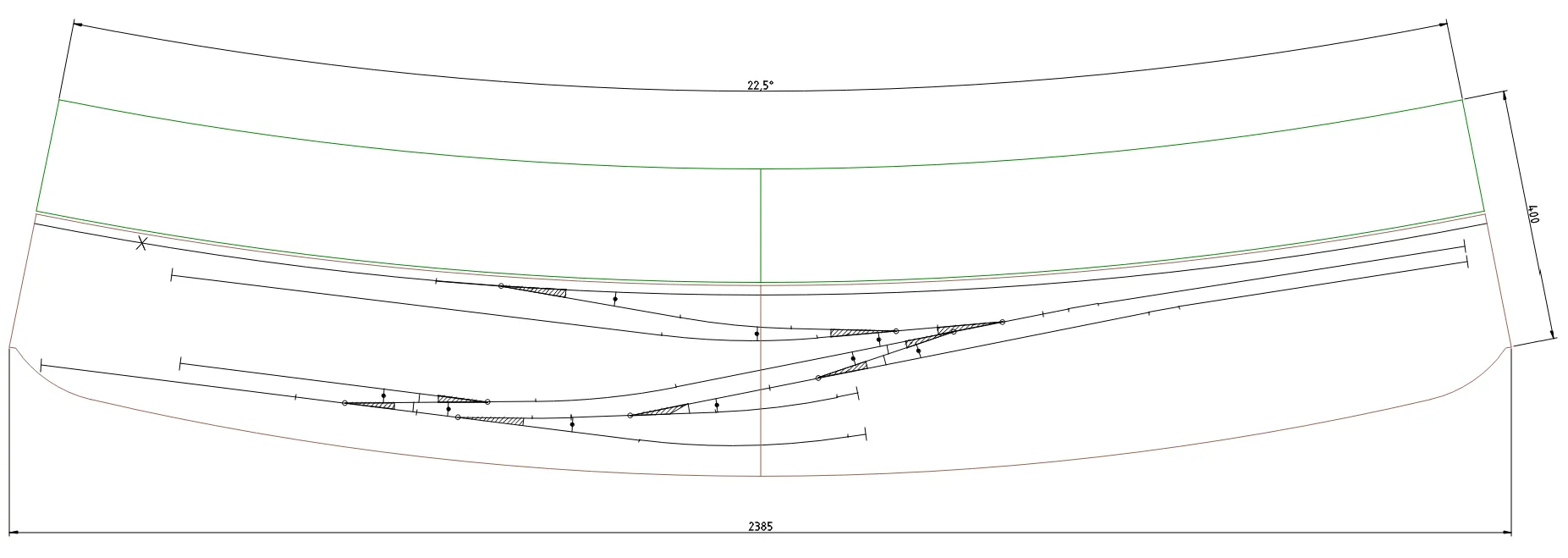
At the top: FREMO module adapter, pure landscape (green); below the two segment boxes (brown) with tracks (black)
The two segments already include the continuous track. The FREMO module adapter is therefore purely a scenery module.
Essentially, the adapter is only used to create the FREMO module head geometry of 400 mm x 100 mm. The FREMO module adapter will be 100 mm high, and the segment boxes will be about 70 mm or so high, so that they can rest on the adapter in a corresponding recess (and, of course, be secured there). See below for more details about the modul box construction.
In reality, the prototype mill site borders directly on residential buildings. These can create a lovely scene on the adapter. Having a look onto the full designed FREMO module:
Click to zoom or download as PDF.
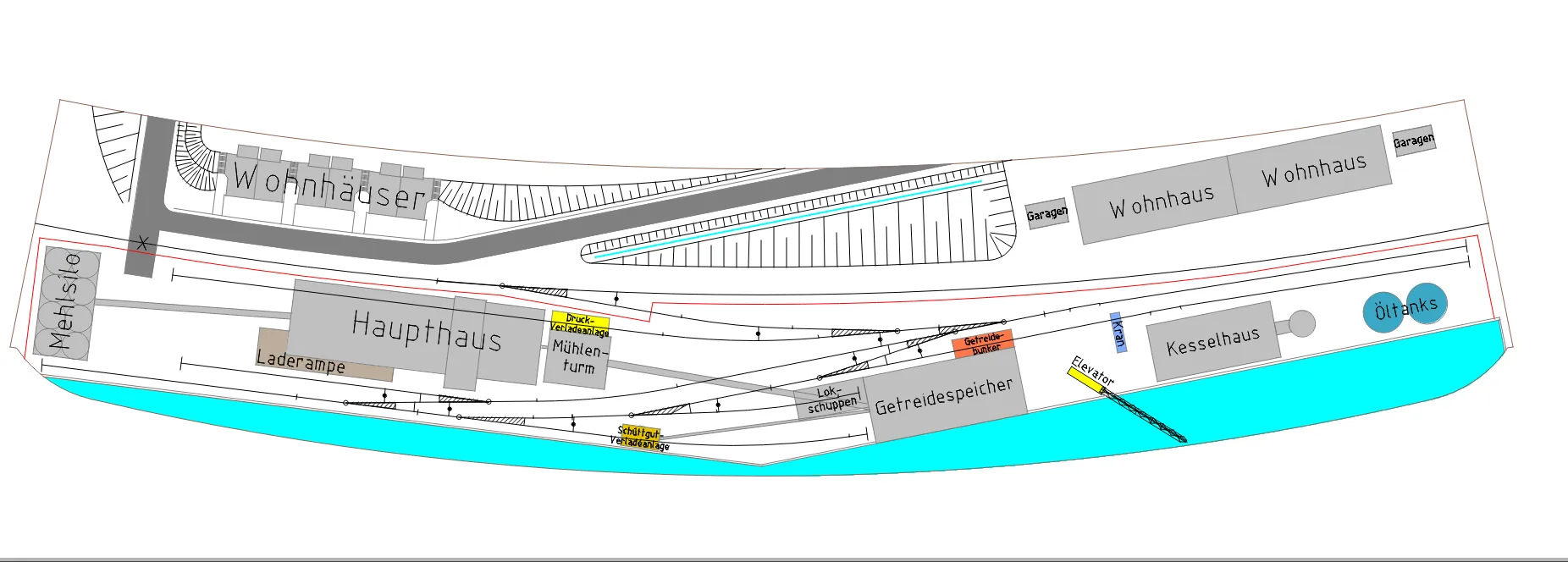
Full view on the FREMO Module
Pictures of the Prototype
Section titled “Pictures of the Prototype”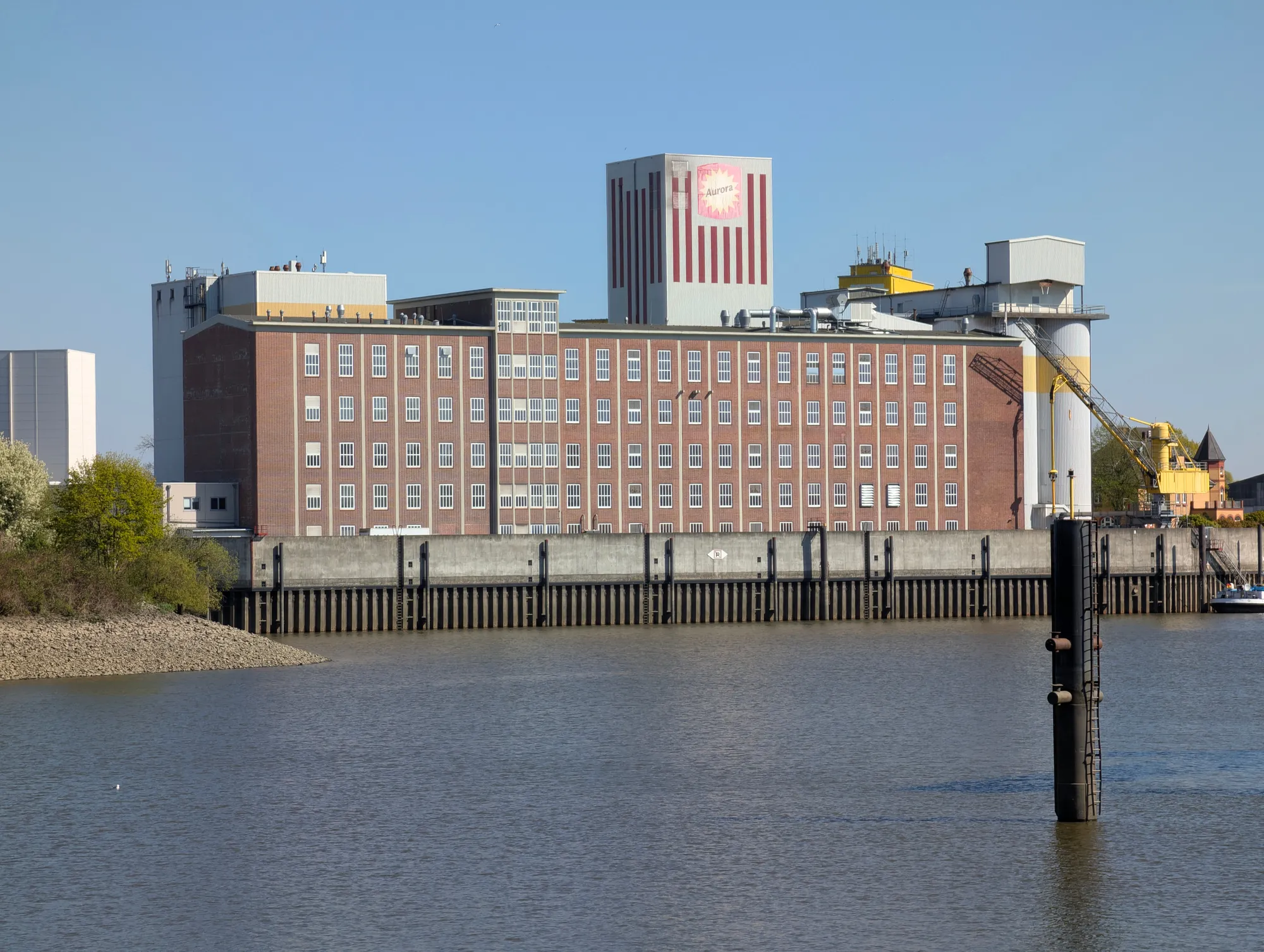
View from the east: the quay and the main building (foreground, centre), Mill tower with the Aurora logo (centre, background), Silo I (half-right behind the main building), Silo II (behind Silo I), elevator crane (yellow, right)
In the original, the main building is about 85 metres long, 20 m deep and 25 m high. In the model, I would probably shorten it in length while taking proportions into account.
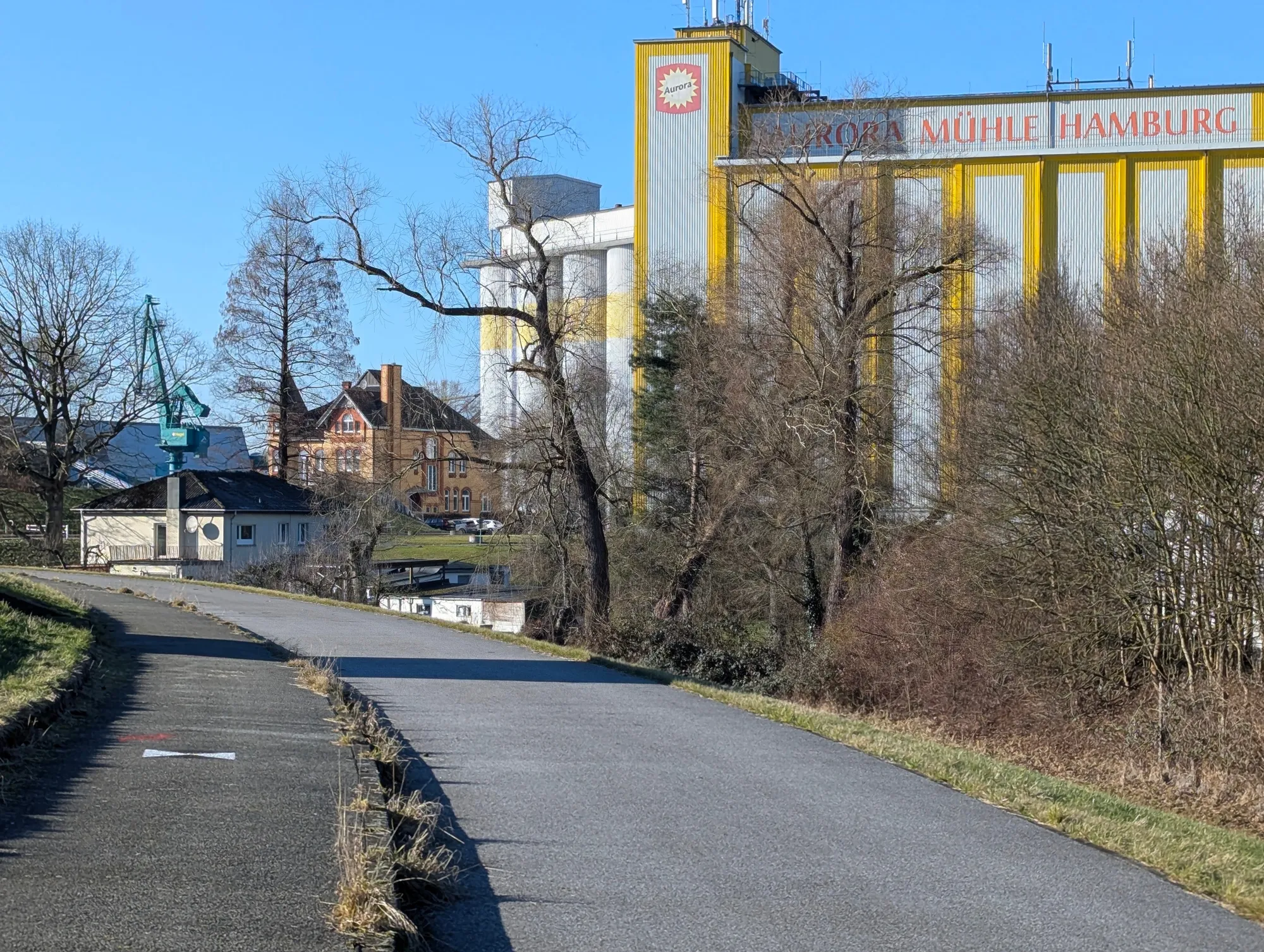
View from the south: [Residential building, harbour crane (left, background)], Plange’s villa (centre left), one of the newer Silos (centre), Silo II (right)
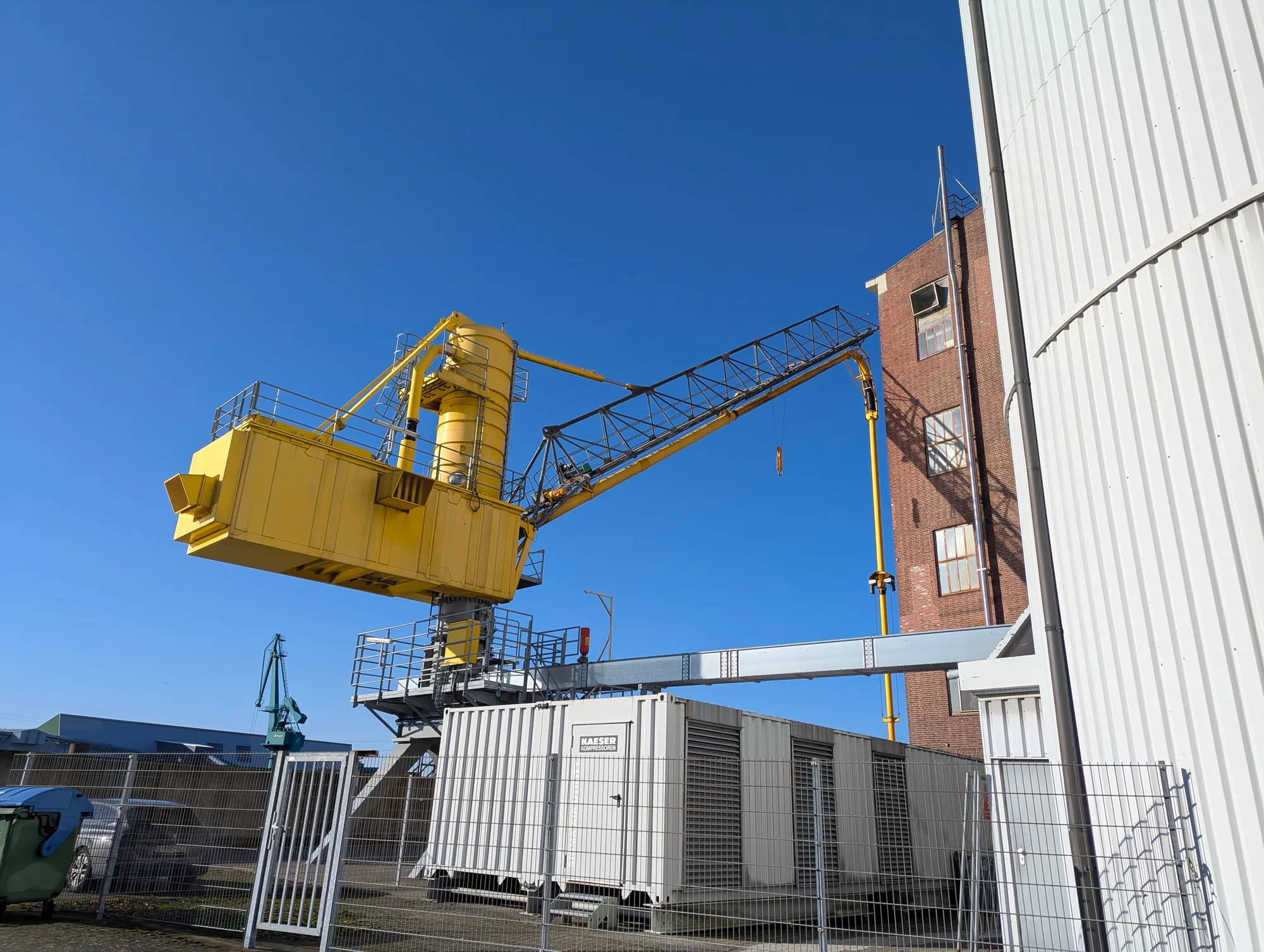
The elevator (grain suction device for unloading ships)
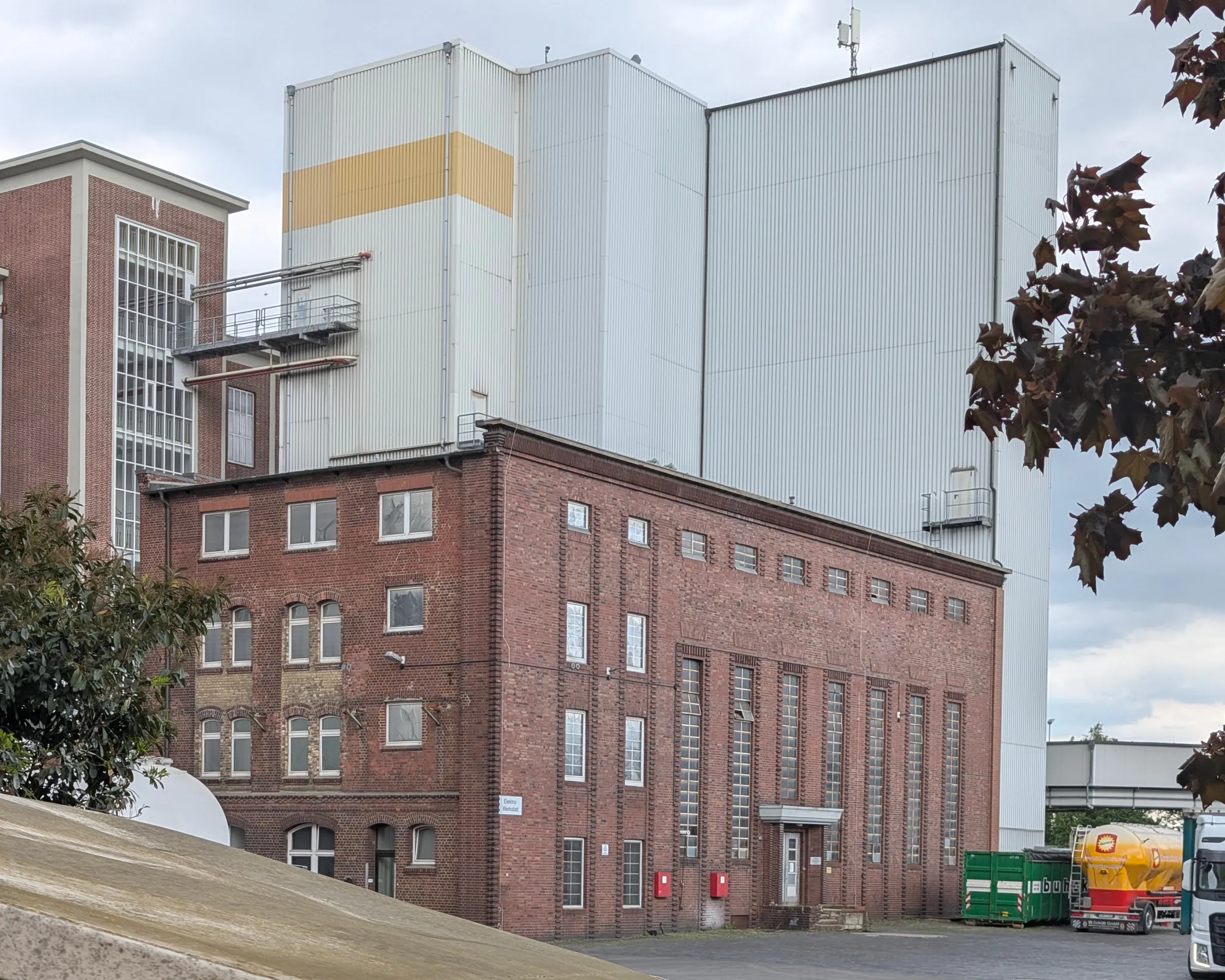
The boiler house
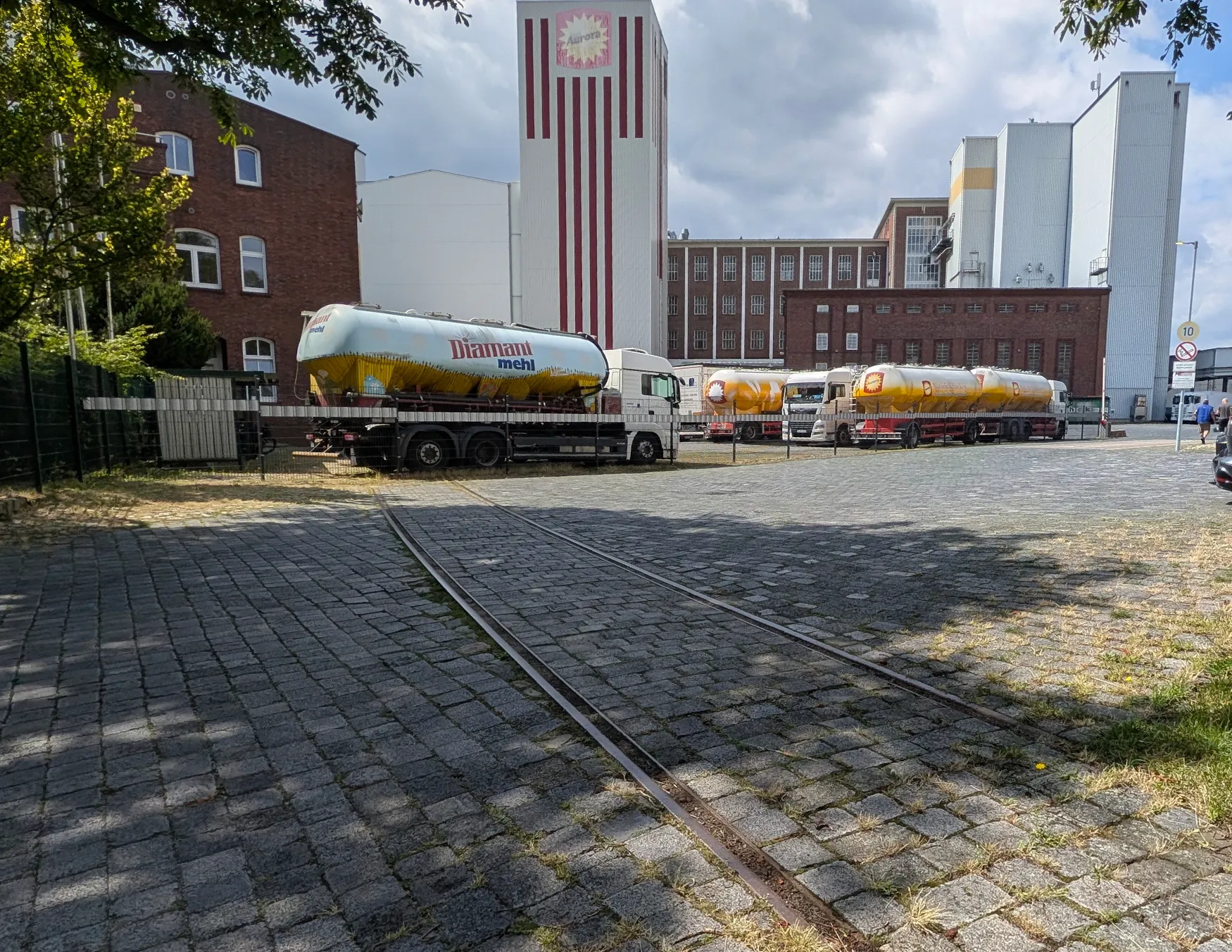
Forground: The faded traces of the former railway siding. Background (left to right): Administration building, Mill tower, the main building (behind), Boiler house (1896/1922), more new silos
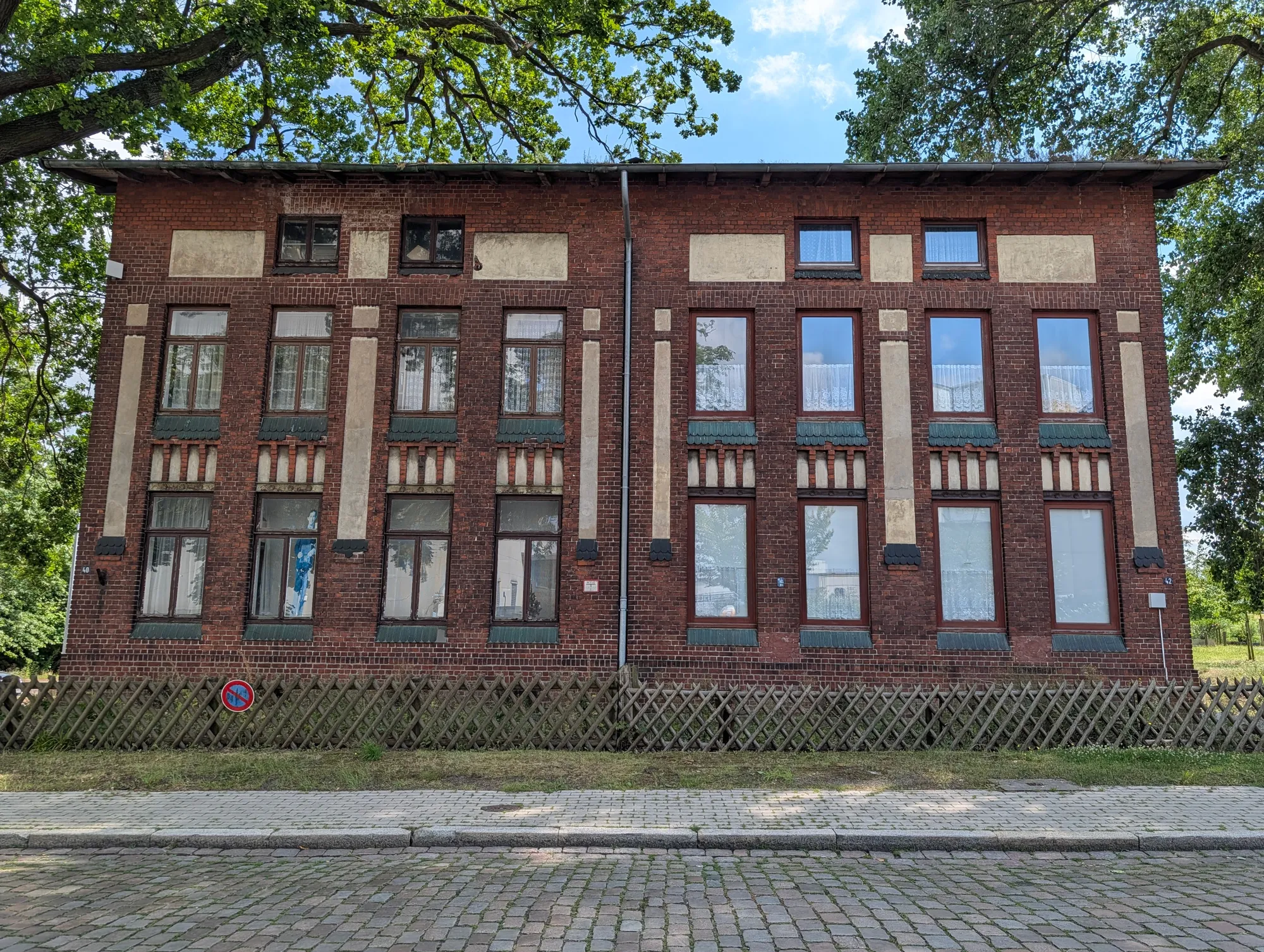
Workers’ accommodation opposite the mill.
Module Box Construction
Section titled “Module Box Construction”The curved shape requires special attention during the construction of the boxes.
In total, there are 4 boxes to be build: for the left segment (A), the right segment (B), the left FREMO adapter (C), and the right one (D). The design principle is the same for all of them: they are constructed using a rib frame design.
The outer two end profiles of the segment boxes measure 215 mm x 70 mm. Together with the FREMO adapter, they form a module end compatible with the N 90 end profile.
The segment boxes rest in a matching cut-out in the FREMO adapter. At the rear vertical edge, the segment end is held in place with a module connector. At the front, it is attached to the FREMO end with a knurled screw.

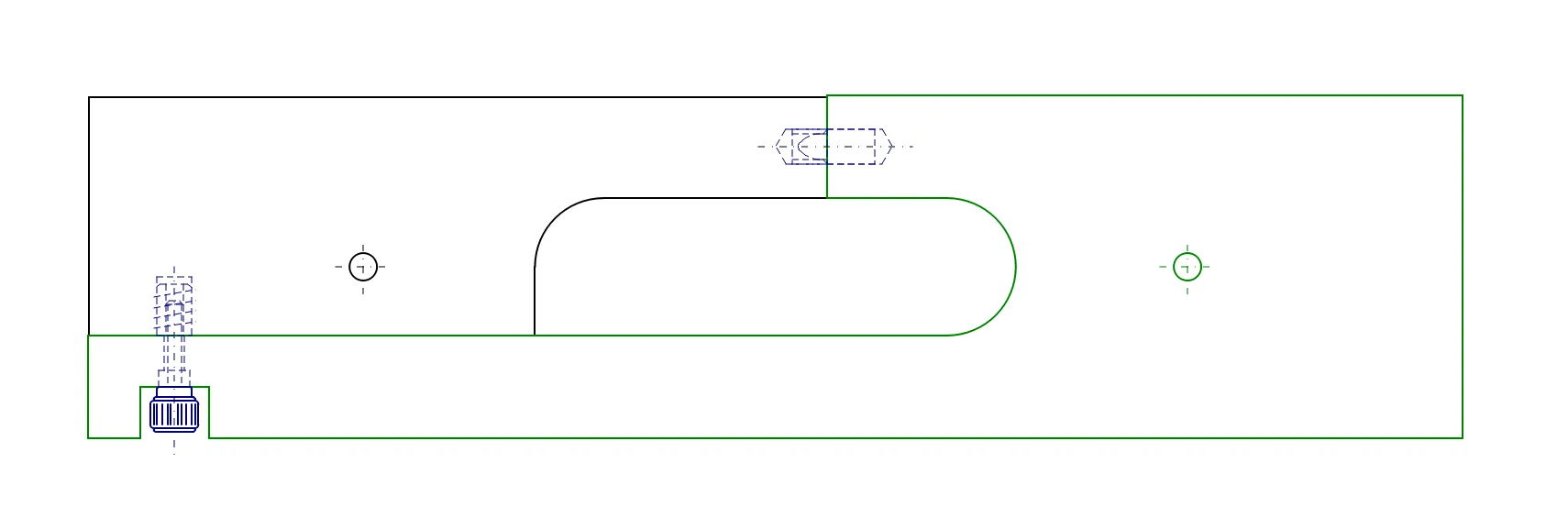
Here you can see how the segment (brown) rests in a cut-out of the FREMO adapter (green) and is secured there (blue). The result is effectively an N 90 end profile.
The end profile plates are made from 15 mm multiplex plywood. 7.5 mm deep rebates and grooves are milled into the end plate for the sides, the longitudinal ribs, and the track bed.
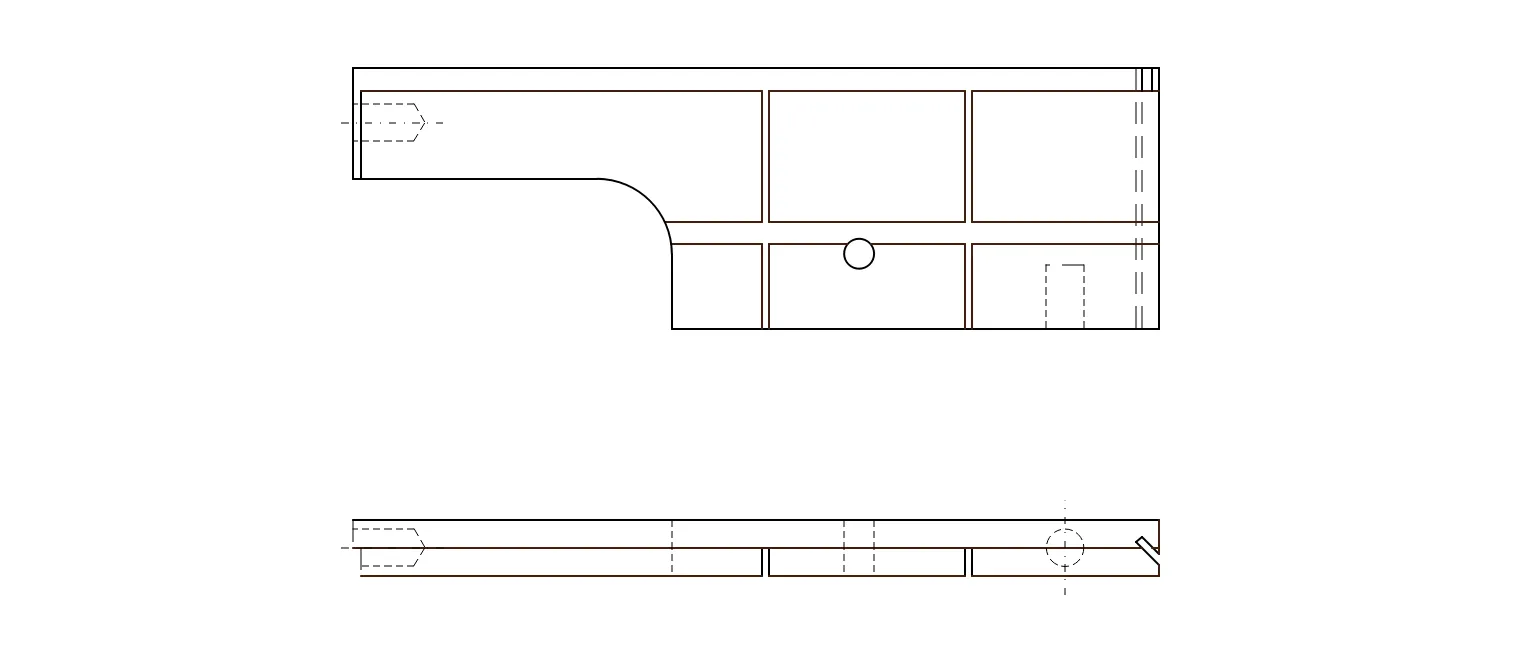
As an example, the right-hand end profile (KB2) of the right segment box: Turn the segment profile plate over so that we can see the inside: The sides, longitudinal ribs, track bed, and riverbed are glued into rebates and grooves in the end profile plate.
The two end profile plates of each box are connected to each other via the side panels and two longitudinal ribs each. For the two segment boxes, one longitudinal rib forms the quay wall and runs straight. All the others form curves, which is why the sides and longitudinal ribs are made from flexible 2 mm aircraft plywood. The sides and longitudinal ribs are connected by 4 cross-ribs made of 6 mm multiplex plywood per box. The longitudinal and cross-ribs are fitted with halved lap joints and glued together.
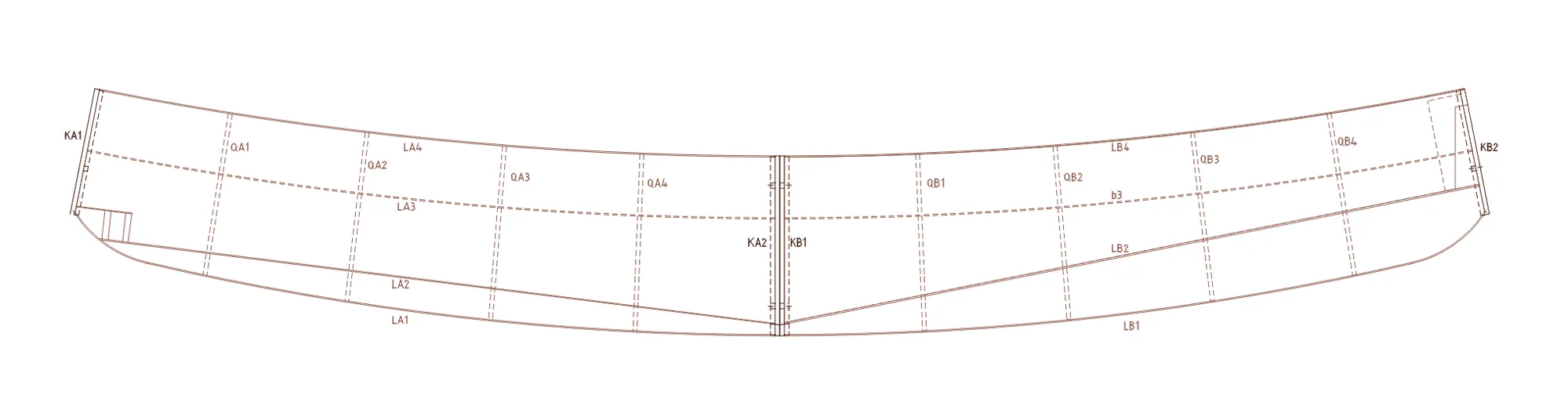
Top view: Both segment boxes joined together. You can see the end profiles as well as the longitudinal and cross-ribs.
The two FREMO adapter boxes are designed in exactly the same way as the segment boxes.
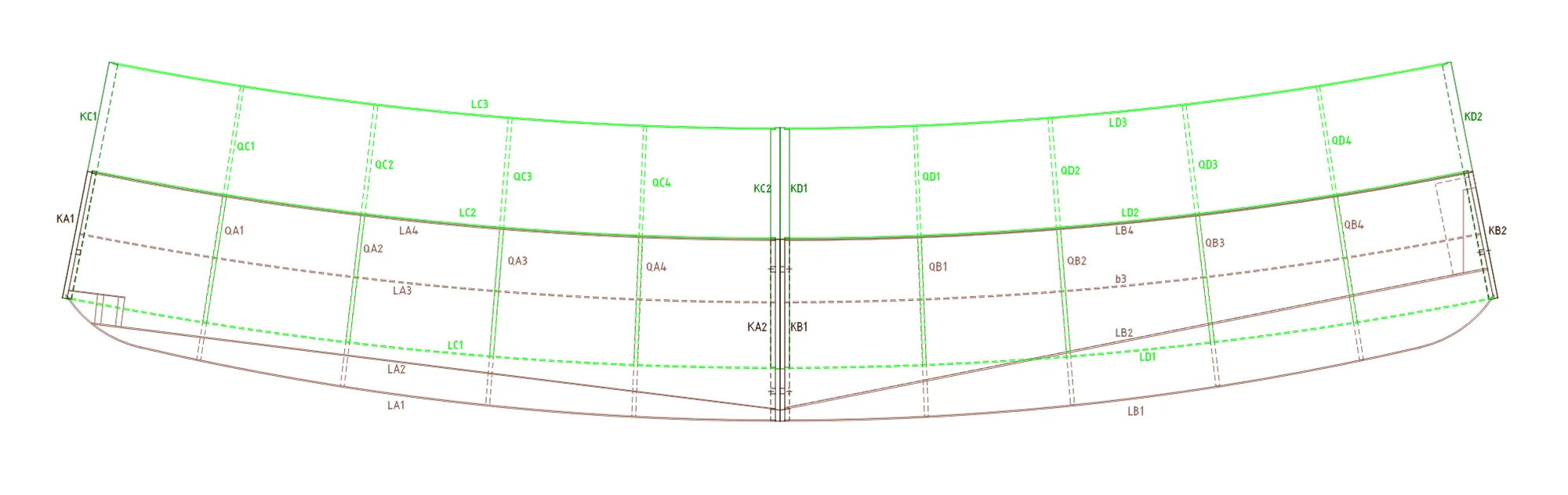
Here, the segment boxes (brown) are resting on the FREMO adapter boxes (green).
Current state
Section titled “Current state”Current state of the planning phase.
Open Topics / Questions about my layout and design
Section titled “Open Topics / Questions about my layout and design”- Is the operational concept coherent and sufficiently realistic for an industrial mill?
- What are the practical dimensions and design for the main building’s loading dock (s. »Laderampe« in my design) At the moment, it’s just drawn out of the blue.
- What is the absolute minimum distance I must keep between buildings and the track in my design – particularly on the inside of the 190m curves? The longest wagons I plan to run are container flat wagons.
Module / Segment Box Construction
Section titled “Module / Segment Box Construction”- My plan is to build the module and segment boxes using a rib frame construction. Is this structure sufficiently rigid, particularly with regard to torsion?
- For the centre connection between the two segment boxes and FREMO adapter boxes, I have currently planned two module connectors as a alignment fit and two wing screws each. Is there a better option, particularly one that allows the boxes to be connected quickly and easily by oneself without any assistance needed?
- How do I assemble the transport boxes?
- How do I assemble the modular legs? How could the transport boxes be used as legs?
- How do I transfer the track layout plan onto the track board? Printing it out on paper and sticking it on causes the paper to expand due to moisture, meaning the dimensions no longer match up perfectly. Don’t know if this will be a problem.
- How will I control and operate the turnouts? Do I need to make provision for this now, whilst the module is being built? For example, to ensure there is sufficient space between the ribs.
Questions for later
Section titled “Questions for later”- What are some good Ucs wagon models for flour? These ones?
- What are good Gs/Hs wagon models for pallets?
- What are goot T wagons models for heavy duty oil?
- What are good flat wagons models for containers?
- How can I describe the layout, the timetable, the track lengths and the turnout schema (here) in a way that fellow players at FREMO meetings can easily understand?
- Are the wagon types listed here correct and complete?
- At least the tracks in the yard run on concrete (slabs) or even better: cobblestones. How do I build that best?
- Is this Minitrix kit any good? Does anyone know the exact dimensions of the tower and the silo? Seems to be the same as this kit from Walthers
Latest changes
Section titled “Latest changes”Track layout:
- Track switch 7/8 in the curve to the right of the loading ramp (more space at the ramp)
Box construction:
- Added most construction details so far
Design:
- Main building extended in legth and loading ramp further to the left
- Compressed air loading at the mill tower (more space in the yard, so that lorry traffic is also plausibly possible)
- Mill silo a bit smaller and positioned furthest to the left (even more space in the yard)
- Detailed landscaping on the FREMO adapter
Version history
Section titled “Version history”| Date | Description |
|---|---|
| 2026-07-27: | This is the latest iteration #21 |
| 2026-06-15: | Here is the previous iteration (#18) |
fiNe-scale is licensed by [dipe] under
CC BY-SA 4.0


